
the October Slide
how am I just finding out about this

In late September 2018, we were scheduled to fly to Long Island for a beach wedding. I had booked a beautiful rental house. The bride and groom had rented a ramp so that I could access the oceanfront deck. But instead of the beach, I spent my week in bed with awful tachycardia episodes, including a night in the hospital where Amelia gallantly held my bedpan.
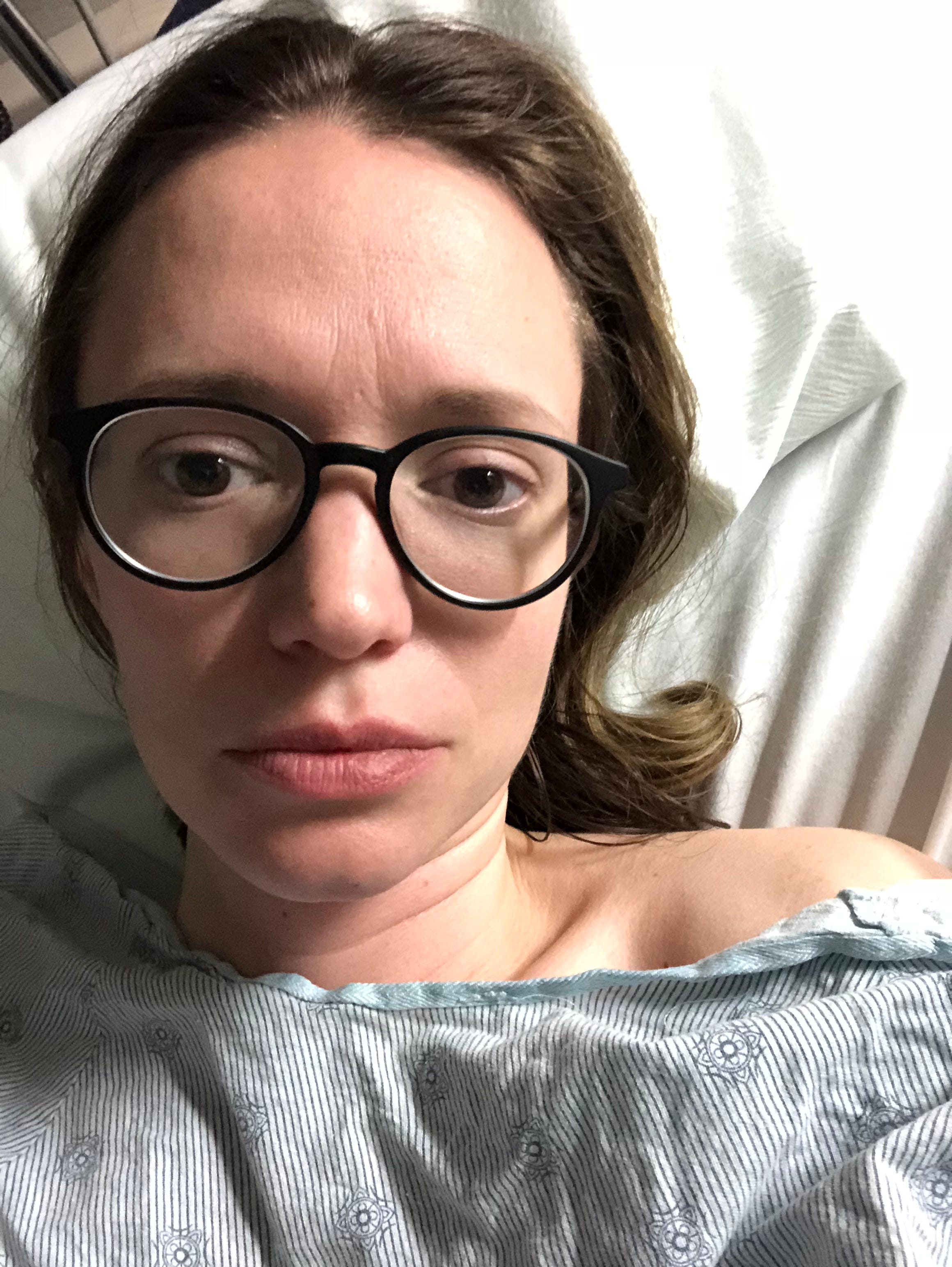
The next year, at the same time, we went to Toronto to see about moving here (spoiler: we eventually did), and I spent most of the trip in bed with tachycardia, nausea, weakness, and vertigo.
I take notes on my health every Monday and so I can look back through the last 13 years in spreadsheet form. I rank each week from 1-10 and write down a few details. As I look back, the very worst times of 2020, 2021, 2022, 2023, and 2024 were the end of September/early October.
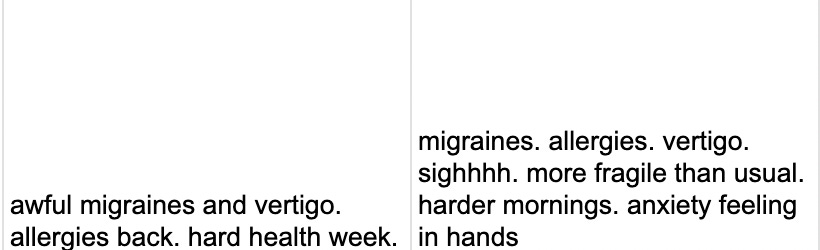
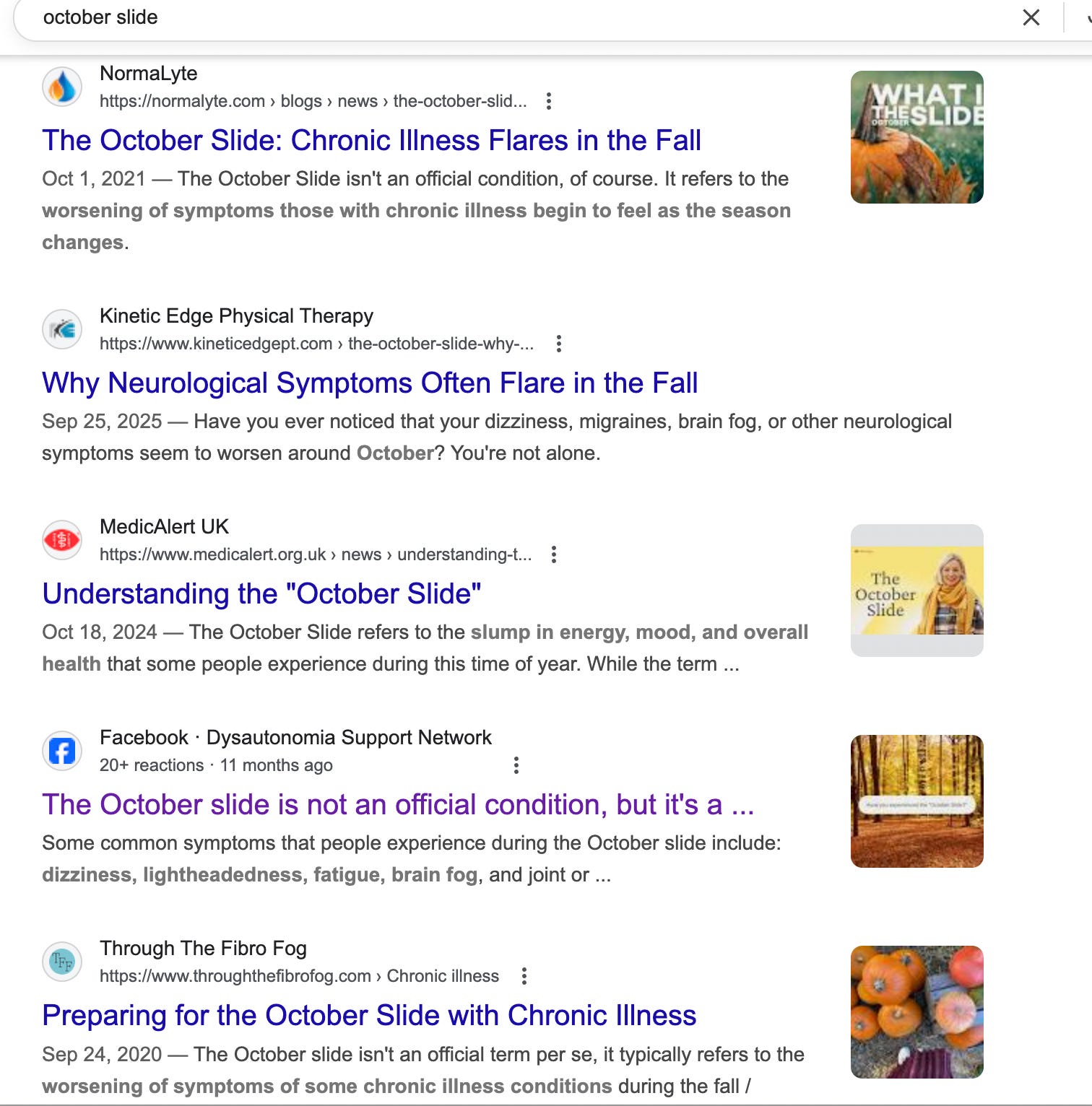
All of this is why I am very surprised that I only heard yesterday of what those in the chronic illness community call the October slide. For some reason, it’s a well-known phenomenon that those of us with sensitive bodies tend to feel particularly bad this time of year.

I learned this because, well, I have been in bed for the last two weeks. I have woken up most days with my heart racing and waves of nausea. I have tried to take walks with F, only to turn my wheelchair around a few houses in because of vertigo. Here I am, October sliding.
What will I do as I approach this time next year? Well, it makes me think about the second arrow of suffering — the way that we, with our own resistance, blame, and judgment, can amplify our own pain. For example, the way that I have felt scared these last few weeks: What is happening to my body? Will it ever stop? Is something more sinister at the root?
David has taken to writing down hard things on our shared Google calendar, with a repeated annual invite. I get an alert reminding me that in December, I often have anxiety around the time that our neighborhood in California caught on fire. In January, an alert tells us that it’s the time of year when the walls at our old house would start cracking in the corners from the cold (we can remove that one now).
I love these alerts because they help with that second arrow. Instead of the mental scramble to make sense of changes, I can just think: ok this is hard, but so it goes, just like it always has.
Nearly a decade ago, I was seeing a physical therapist who specialized in EDS. I really liked him. I still do his exercises. One day, as we were fine-tuning my approach to the nerve pain in my arm, I made a throwaway comment about the fact that I will always be in pain. I said this because my body has hurt every moment of my life, and there is no reason to think it will stop. It is the nature of my collagen. I do my very best to take care of my joints and muscles and to ease my own suffering but pain has been, and will be, there.
My PT was so mad. He said that with a mindset like that, I was ensuring that my pain wouldn’t improve. That I had to believe I could fully recover, so that I would. I found his response so jarring. Why would I believe that? There is absolutely no evidence that even the most diligent approach to PT will fix the structural integrity of my connective tissue.
If determination and relentlessness could solve my problems, I would live in a state of bliss. But that’s not how this life works.
My body will hurt, I’ll get worried in December, a house we no longer own will get a few new cracks in the deep Canadian winter, and, as I now know, in October, I’ll slide.
I didn't know about the October slide, either. This helps explain why my old ankle injury is suddenly swollen again for no apparent reason. I was racking my brain yesterday, wondering, did I overdo it? Then I put on the compression socks I haven't worn for many months.
I have also had the experience with providers that you had with your PT. I have an appointment with my rhuematologist this week and I was debating whether I should lie to her about my ankle pain and swelling. I know that she can't fix it. I know that I can't fix it. I know that this is just a reality of living in my body, that occasionally my symptoms flare and my body hurts more for no apparent reason. And I know from experience that if I'm honest with her about my symptoms, she will find a way to blame me for it (i.e. "Aren't you doing the ankle exercises I told you to do?! Are you massaging it every night? Stop eating sugar!"). I've noticed over the years that providers seem to think they are failing if they can't cure your symptoms, which makes them defensive. I think it's much more practical for both providers and patients to understand that sometimes this is as good as it gets, and it's not because anyone failed. It just is what it is.
OMG this is so helpful. I've had a hard couple of weeks -- a flare-up, for sure. My left hip has started giving me a lot of trouble, which is new, and I've been so exhausted that today's the first day in several days that I've been able to work or even really be out of bed for a sustained period. And then the second arrows have really been flying. "I've let myself get deconditioned so the pain and fatigue are my fault" -- my mind's absolutely most common refrain for as long as I can remember.
I'm trying to cultivate the view that I was born not only with this body but also with this personality. Some people manage to get up and at 'em and keep living their lives and exercising regularly even when they're tired and in pain, but I'm not one of them, and that wasn't my choice. If it were easier for me to move more, I would.